Ham Radio Log Book KDP Interior: A Practical Tool for Organized Operators
For amateur radio enthusiasts, logging contacts is not merely a hobbyist tradition; it’s a fundamental practice. It serves as a legal record, a personal journal of technical achievement, and a critical database for award applications and network analysis. The Ham Radio Log Book KDP Interior addresses this core need with a structured, professional approach. It is designed not as a standalone product, but as a key component in a creator’s workflow—specifically, for those looking to publish a physical or digital log book through Amazon’s Kindle Direct Publishing (KDP) platform.
Integration into the KDP Publishing Process
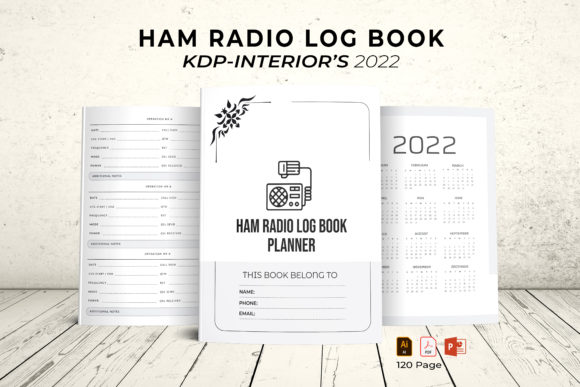
Understanding where this interior fits begins with the KDP process itself. An author or creator must provide a formatted manuscript file. For a log book or planner, this means designing every page: contact log templates, calendar pages, indexes, and cover art. The Ham Radio Log Book KDP Interior eliminates the design and formatting hurdle. It is a pre-built, tested template file. Its role is after the conceptual decision to create a log book, and before the final upload to KDP. It sits squarely in the execution phase of the project, bridging the gap between idea and finished product.
This interior interacts directly with other essential tools in a publisher’s toolkit. The primary files provided—Adobe Illustrator (.AI/.EPS), Microsoft PowerPoint (.PPT), and JPEG/PDF—offer flexibility. A user with graphic design skills can use Illustrator for deep customization. Someone proficient in office software can efficiently modify layouts and text in PowerPoint. The JPEG and PDF files serve as quick-reference visuals or as final, print-ready uploads. This multi-format approach ensures compatibility, allowing the creator to work within their existing software ecosystem without forcing a learning curve on new, expensive applications.
Practical Implementation and Customization
The true value of a template lies in its adaptability. The specifications of this interior, such as US Letter size (8.5 x 11 inches), no bleed, and 300 DPI resolution, are pre-optimized for KDP’s paperback interior requirements. This removes the risk of technical rejection during upload. The practical implementation starts with the editable files.
Workflow Example: Creating a Branded Log Book
Imagine an established ham radio club wants to produce a yearly log book for its members. A member, acting as the project lead, acquires the Ham Radio Log Book KDP Interior. Their workflow might proceed as follows:
- Assessment: Open the PowerPoint (.PPT) file. This format is often the most accessible. Survey the 120-page structure: the cover page, the 2022 calendar, and the multitude of vector-shaped log pages.
- Customization: Change the title on the cover page to include the club’s name. Using the “easy to change colors” feature, alter the accent colors to match the club’s logo. Insert the club’s call sign or emblem into the header of the log pages.
- Quality Control: Scroll through every page in the PPT view to ensure consistency. Check that the log fields (date, time, frequency, station call sign, remarks) are clear and properly aligned. Since the shapes are vector and re-sizable, minor adjustments to cell sizes can be made if needed.
- Finalization: Once satisfied with the edits in PowerPoint, the creator can save a high-quality PDF directly from the software. This PDF, sized 8.5 x 11 inches with no bleed, is now the “print-ready file” ready for KDP upload. Alternatively, they could send this PDF to a local print shop for club distribution.
This process highlights efficiency. The creator spends time on branding and content decisions, not on drawing table lines or calculating page margins. The template provides the organizational framework, ensuring a professional baseline quality, while the user injects the specific character and purpose.
Factors for Long-Term Usability and Consistency
For entrepreneurs or small business owners looking to sell log books on KDP, consistency across editions is key for brand recognition. The editable vector nature of the core files makes this sustainable. After successfully publishing the 2022 edition using this interior, a creator can use the same Illustrator file as a master template for the 2023 version. They would update the calendar page, perhaps tweak the color scheme, and systematically produce a new product with a familiar, trusted layout. This promotes long-term usability, turning a one-time purchase into a reusable asset for annual publications.
Usability also extends to the end-user—the ham radio operator who purchases the published log book. The interior’s design, by virtue of being formatted for clarity, directly impacts their daily logging experience. Well-organized fields reduce entry time and error during operation. A clean layout with sufficient space for remarks aids in post-contact analysis and record-keeping. The included 2022 calendar provides quick date reference without needing a separate planner. Thus, the quality control applied by the template creator (using this interior) cascades down to the operator, enhancing their workflow as well.
Beyond Log Books: Applications in Related Workflows
The utility of the Ham Radio Log Book KDP Interior can extend into adjacent projects. Its structure is fundamentally a hybrid of a planner and a specialized data-logging tool. Bloggers or educators creating instructional material about ham radio could use customized pages from the interior as visual aids in guides or tutorials. Freelancers offering services to the amateur radio community might use the PDF as a prototype to demonstrate a client’s custom log book concept.
Furthermore, the “fully editable vector” aspect means the shapes are not locked to radio logging. A creatively-minded user could, with significant modification, repurpose the table frameworks for other hobbyist logging needs—such as astronomy observations, wildlife tracking, or even project management task tracking. While this requires more effort, the underlying principle of a ready-to-format, print-optimized page grid remains a valuable starting point for various data organization projects destined for physical publication.
Key Considerations for Smooth Integration
To integrate this interior smoothly into your work, focus on preparation and a clear outcome.
- Define Your Output First: Decide if your final goal is a KDP paperback, a home-printed booklet, or a digital PDF for distribution. This determines which final file format (PDF for KDP/printing, maybe JPEG for web) you will need to produce from the editable sources.
- Match Software to Skill: Honestly assess your comfort with design software. If Illustrator is unfamiliar, the PowerPoint option provides most necessary editing capabilities without complexity.
- Batch Your Edits: Work systematically. Edit global elements like colors and headers first, then page-specific elements. This maintains consistency across the 120-page document.
- Utilize the No-Bleed Design: The “No Bleed” specification simplifies printing. It means all content is safely within the page margins, ideal for standard home or office printers and perfectly acceptable for KDP paperback interiors. You do not need to worry about complex bleed area design.
The Ham Radio Log Book KDP Interior is, in essence, a process accelerator. It translates the intent to create a professional, useful log book into a tangible, market-ready product by handling the foundational layout work. It integrates not by replacing creativity, but by supporting it, providing a robust, adaptable framework upon which personalized, practical tools for the ham radio community—and beyond—can be efficiently built and published.