The Hidden Canvas: Why Hex Paper Is a Game Designer's Best Friend
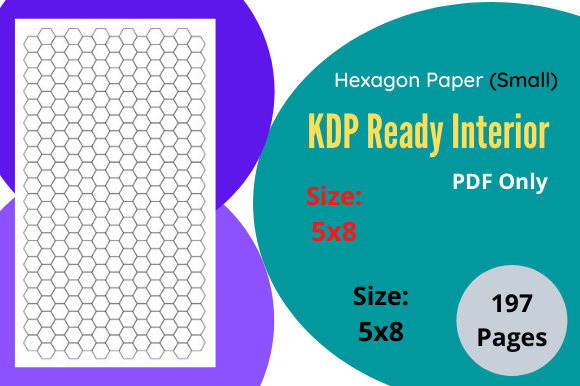
For anyone involved in the vibrant world of creative gaming, from the dungeon master sketching a labyrinth to the artist doodling geometric patterns, there's a specialized tool that often goes unnoticed but is incredibly powerful: hex paper, often referred to as honeycomb paper. This simple grid of interconnected hexagons isn't just another type of graph paper; it’s a foundational element for planning, designing, and visualizing complex spaces. And when this tool is packaged in a format like 5x8 KDP Interiors, it becomes a highly practical, portable asset ready for any project.
Unlocking Spatial Strategy: The Hexagon's Unique Advantage
Why hexagons? The answer lies in geometry and practicality. Unlike a square grid, a hexagon allows for six equidistant neighbors. This creates a more natural and fluid representation of movement and adjacency. When you’re drawing a game map, whether for a tabletop roleplaying game (RPG) or a wargame, this translates directly to clearer movement paths, more realistic terrain boundaries, and easier calculation of distances. It removes the ambiguity of diagonal movement on a square grid. This is why hex grids have been the backbone of strategic board games and computer game maps for decades.
The utility extends beyond pure gaming. Artists and doodlers find the honeycomb pattern a stimulating constraint, a framework that encourages tessellation and complex pattern design. The repeating hexagon can be a building block for mandalas, organic shapes like honeycomb or scales, and intricate geometric art. It’s a structured canvas that sparks creativity rather than limiting it.
The Perfect Match: Tabletop RPGs and Hex Paper
Consider a Dungeons & Dragons session. The party is exploring a vast, uncharted forest. On standard paper, drawing this forest with clear paths, clusters of trees, and enemy encounter zones can be messy. On hex paper, each hex can represent a specific type of terrain—one hex for dense woods, the next for a rocky clearing, another for a shallow stream. Movement is intuitive: moving from one hex to an adjacent hex is one move action. This visual clarity speeds up gameplay immensely, allowing the Dungeon Master to focus on the narrative rather than navigating a confusing map.
For wargamers, the precision is even more critical. Positioning units, calculating line of sight, and determining range for attacks are core mechanics. A 5x8 KDP Interiors hex paper template provides a clean, consistent battlefield to plan tactics or record legendary matches. The small 5x8 format is particularly handy for sketching out smaller encounter zones or single battlefields before committing to a larger campaign map.
Beyond the Table: Digital Planning and Personal Projects
The influence of hex paper isn't confined to physical tables. Many video game designers and indie developers use hex grids in their initial planning phases. Sketching out a world map, village layout, or dungeon level on physical paper can be a faster, more tactile brainstorming process before moving to digital tools. Having a ready-made 5x8 KDP Interiors hex pad means these ideas can be captured anywhere, anytime, without needing to open a software program.
Board game enthusiasts also use it for prototyping. Designing your own game mechanics often requires a functional play area. Hex paper allows for rapid iteration of board layouts. You can sketch, play a test round, adjust the hexes, and redraw without starting from scratch. It’s a low-cost, high-reward method for game development.
Quality in Your Hands: What Makes a Good Hex Paper Template
Not all hex paper is created equal. For professional or serious amateur use, several factors matter. The line weight should be clear but not overpowering, allowing your drawings to stand out. The paper itself should be of good quality to handle pencil, ink, or even light marker use without bleeding through excessively. This is where specifications like high-quality resolution files at 300 DPI become important. They ensure that whether you’re printing the template yourself or using it as part of a 5x8 KDP Interiors ready-to-upload PDF, the final product is sharp and precise.
The inclusion of a bleed in the file is a technical consideration often overlooked by users. Bleed ensures that if the pages are ever trimmed or bound, the hex grid runs right to the edge without awkward, incomplete hexagons at the margins. It’s a sign of a professionally prepared template designed for real-world use, not just a quick digital sketch.
Integrating Hex Paper into Your Creative Workflow
How do you actually use this tool? Start by identifying its role in your process. Is it for in-session, live map drawing during a game? Then a printed 5x8 notebook or pad is ideal—compact enough to fit beside your rulebooks. Is it for pre-planning campaign maps? You might want to print larger sheets, but having the 5x8 PDF as a master template gives you consistency across all your maps.
For artists, it can be a dedicated sketchbook for pattern studies. The structured grid helps train the eye for symmetry and space. Gamers moving between digital and analog might use the hex paper sketches as reference documents to share with online play groups, using the clear 300 DPI scans as a perfect digital handout.
The key is accessibility. Because a 5x8 KDP Interiors file is ready to upload, it can be easily turned into a physical product through print-on-demand services or simply printed at home. This removes the barrier of having to search for or create your own hex grid every time you need one.
Choosing Your Tools: Factors to Consider
Before committing to a specific hex paper template, think about your primary use case. If portability is paramount, the 5x8 size is a significant benefit. Do you need to bind many pages together into a campaign journal? Ensure the template includes proper margins and bleed for binding. Are you sharing your maps digitally? The high-resolution file quality will matter for clarity when scanned or uploaded.
Also, consider the density of the hex grid. Some templates have larger, fewer hexes for broader strategic planning, while others have smaller, more numerous hexes for detailed dungeon corridors. The template described here, with its professional 300 DPI and bleed setup, is geared towards versatile, detailed work suitable for both gaming and art.
Ultimately, hex paper, especially in a polished format like 5x8 KDP Interiors, is more than just paper. It’s a specialized interface between your ideas and their realization. It provides the structure that frees your creativity, whether you’re orchestrating an epic fantasy battle, designing the next great indie game, or simply exploring the beautiful geometry of the hexagon. In a world of digital tools, sometimes the most powerful solution is a simple, perfectly prepared blank grid waiting for your mark.